
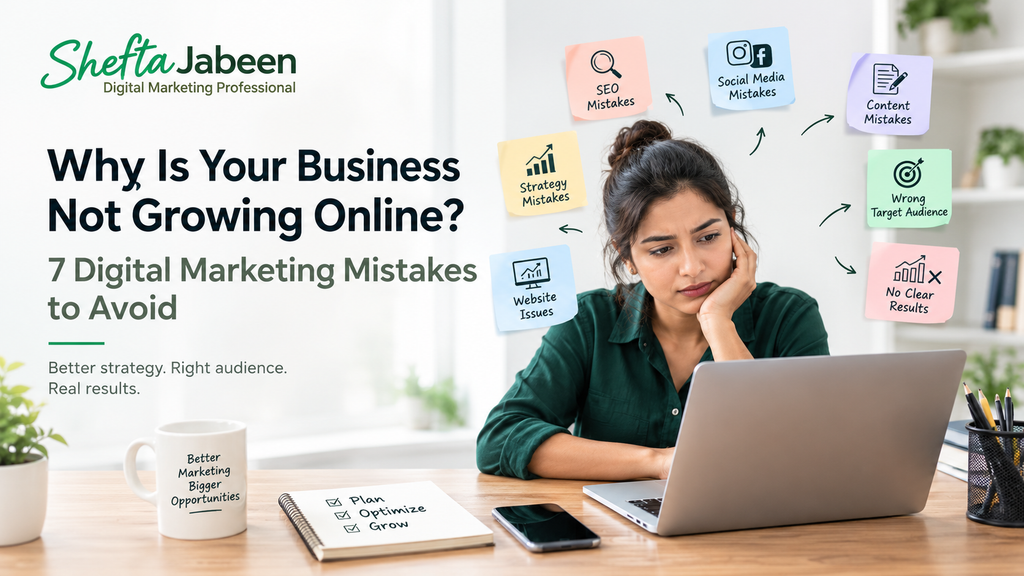
You have a website, post regularly on social media, and perhaps even spend money on online advertisements. Yet, your business is not getting enough traffic, engagement, or enquiries.
What could be going wrong?
The problem may not be a lack of effort. Sometimes, businesses make common digital marketing mistakes that prevent them from reaching the right audience or achieving their goals.
The good news is that these problems can often be addressed with a clearer strategy and a better understanding of your audience.
Let’s explore seven mistakes that may be holding your business back and what you can do differently.
1. Marketing Without a Clear Strategy
Posting on Instagram today, writing a blog tomorrow, and running advertisements next week may keep you busy, but these activities won’t necessarily grow your business.
Without a clear strategy, it becomes difficult to decide where to invest your time and budget.
Start with a Clear Marketing Plan
Begin by identifying your business goals. Do you want more website traffic, qualified leads, brand awareness, or sales?
Next, understand your target audience and choose marketing channels that suit their needs.
For example, a local service business may benefit from local SEO and customer reviews, while an online store may focus on product pages and targeted advertising.
Practical tip: Set one clear marketing goal for the next 90 days and choose activities that support it.
2. Ignoring Search Engine Optimization (SEO)
A professional website is not enough if potential customers cannot find it on Google.
Search engine optimization (SEO) helps improve your website’s visibility in relevant search results. Without it, you may miss opportunities to reach people already looking for your products or services.
Make Your Website Easier to Find
Start with these essential SEO practices:
- Research keywords your potential customers use.
- Create useful and relevant website content.
- Optimize page titles and headings.
- Check indexing issues using Google Search Console.
- Improve mobile usability and website performance.
- Use local SEO if you serve customers in a specific area.
For example, a renovation company could publish a guide on planning a home renovation budget to answer questions potential customers have before hiring a professional.
SEO takes time, but consistent improvements can help your website attract relevant visitors.
3. Posting on Social Media Without Understanding Your Audience
Posting regularly does not guarantee engagement or enquiries. If your content doesn’t address your audience’s interests or problems, people may simply scroll past it.
Repeatedly promoting your services can also make your social media presence feel like advertising rather than a useful resource.
Create Content Your Audience Cares About
Understand what your audience wants to learn and create content around those needs.
A balanced content plan can include:
- Educational posts: Tips, tutorials, and helpful information.
- Trust-building posts: Genuine reviews, work examples, and your process.
- Engagement posts: Questions and relevant discussions.
- Promotional posts: Your services and how they help customers.
For example, instead of repeatedly advertising SEO services, share common reasons websites struggle to attract traffic.
This gives your audience useful information while demonstrating your expertise.
4. Creating Content Without Providing Real Value
Publishing blogs and social media posts consistently is helpful, but content needs a clear purpose.
Generic articles and repetitive posts may fail to answer the questions your audience actually has.
Focus on Helping, Not Just Publishing
Before creating content, ask yourself: What useful information will the reader gain from this?
Instead of writing a broad article about digital marketing, consider a specific topic such as “Why Is My Website Not Getting Traffic from Google?”
You can also create content for different stages of the marketing funnel:
| Funnel stage | Content examples |
| TOFU — Awareness | Educational blogs and common mistakes |
| MOFU — Consideration | Guides, comparisons, and checklists |
| BOFU — Decision | Service pages and relevant case studies |
Each article should solve a particular problem and help readers take the next step in their journey.
5. Trying to Reach Everyone Instead of the Right Audience
When your marketing message tries to appeal to everyone, it can become too broad to connect with the people most likely to need your services.
Customers have different needs, budgets, and expectations. Your content should make it clear whom you help and what problems you solve.
Define Your Ideal Customer
Identify your ideal audience by considering:
- Their needs and challenges.
- Their industry or business type.
- Their location, where relevant.
- Their budget and purchasing concerns.
- The questions they ask before buying.
For example, a digital marketer targeting small businesses could create content about local SEO, website visibility, and lead generation.
Specific, relevant content makes it easier for potential customers to understand the value you offer.
6. Ignoring Website User Experience
Your website may attract visitors, but a confusing layout, slow pages, or difficult navigation can discourage them from exploring further.
If visitors cannot quickly understand your services or find your contact details, they may leave without enquiring.
Make Your Website Easy to Use
Review your website from a visitor’s perspective.
- Make sure it works well on mobile devices.
- Keep navigation simple and clear.
- Improve page performance where necessary.
- Explain your services in straightforward language.
- Make contact details and calls to action easy to find.
You can use Google Page Speed Insights to identify potential performance issues.
A website should not only look professional; it should also help visitors find information and take action easily.
7. Measuring Likes and Traffic Instead of Results
Followers, likes, and website visits can look impressive, but they don’t always indicate business growth.
A website might attract many visitors without generating enquiries. Another page might receive less traffic but attract more relevant potential customers.
Track What Actually Matters
Measure your performance according to your business goals.
| Goal | Metrics to monitor |
| Improve search visibility | Impressions and clicks |
| Increase website traffic | Organic sessions |
| Improve social media performance | Shares, saves, and meaningful engagement |
| Generate enquiries | Qualified leads and form submissions |
| Measure advertising performance | Cost per lead and conversion rate |
Tools such as Google Analytics and Google Search Console can help you understand your performance.
Review the results regularly and use the information to improve your strategy rather than relying on assumptions.
A Simple Action Plan for Better Online Growth
You don’t need to fix every problem at once. Start with these five steps:
- Identify the problem: Determine whether your biggest challenge is traffic, engagement, or enquiries.
- Review your marketing: Check your website, content, and current strategy.
- Choose one improvement: Focus on a change that directly addresses the problem.
- Measure the results: Track relevant metrics to understand what changes.
- Adjust your approach: Use what you learn to plan your next steps.
Small, informed improvements can help you make better use of your marketing resources.
Conclusion
If your business is not growing online, publishing more posts or spending more on advertisements may not be the answer.
Start by reviewing your strategy, understanding your audience, creating useful content, improving your website, and tracking meaningful results.
Digital marketing takes time, and outcomes depend on your industry, competition, and execution. However, a clear strategy and consistent improvement can help you build a stronger online presence.
Frequently Asked Questions
1. Why is my business not growing online?
Common reasons include an unclear marketing strategy, poor search visibility, irrelevant content, and a difficult website experience. Identify the main issue before deciding what to improve.
2. Which digital marketing strategy is best for small businesses?
It depends on your goals and audience. SEO can improve search visibility, social media can build awareness, and paid advertising can help reach targeted audiences.
3. How long does digital marketing take to show results?
Timelines vary. Advertising may generate traffic soon after launch, while SEO often requires several months of consistent effort. Results are not guaranteed.
4. Is SEO important for small businesses?
SEO can help potential customers discover your business when they search for relevant products, services, or information.
5. How can I measure digital marketing success?
Track metrics such as organic search clicks, qualified enquiries, conversion rates, and advertising costs based on your business objectives.